In the Boat Together
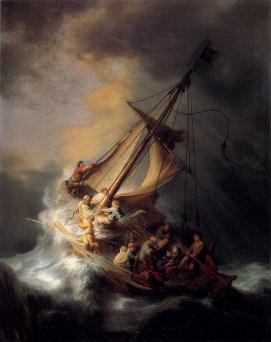
On that day, when evening had come, he said to them, “Let us go across to the other side.” And leaving the crowd behind, they took him with them in the boat, just as he was. Other boats were with him.
A great windstorm arose, and the waves beat into the boat, so that the boat was already being swamped. But he was in the stern, asleep on the cushion; and they woke him up and said to him, “Teacher, do you not care that we are perishing?”
He woke up and rebuked the wind, and said to the sea, “Peace! Be still!”
Then the wind ceased, and there was a dead calm. He said to them, “Why are you afraid? Have you still no faith?”
And they were filled with great awe and said to one another, “Who then is this, that even the wind and the sea obey him?
The View from the Boat
Thanks entirely to the kindness of friends, my wife Sarah and I spent five days this week on the island of St. Martin. I had never been to the Caribbean, It is a wonderful and relaxing place; you should go.
As people tend to do when they vacation in that part of the world, we spent a lot of time sitting on a beach looking out at the calm, bright blue water. As I say, very peaceful and relaxing; but the view can seem a little limited.
Sarah had been to the Caribbean before, as a college student sailing with a group of friends. She recalled that the view from the ocean was much more expansive, taking in as it must a broader view of the land, the contours of hills, and the full sweep of beach.
Perhaps that’s why Jesus liked preaching from the boat, set off as it was from the shoreline. It offered a broader view of things.
It had been a busy and hectic few weeks. He had spent so much time in the midst of the crowd; so much time healing the physically ill and spiritually tormented, so much time given over the meeting the needs of the hungry and the afflicted, that perhaps he needed some perspective. Perhaps the boat gave him the space to see the world and his place in it from a fresh vantage point.
Perhaps we all need from time-to-time, that platform from which we can view our world and the people with whom we share it through a different lens.
Perhaps in putting out to sea, Jesus offers us a useful symbol of how the life of faith can sometimes work.
Because if faithfulness and faithful living is indeed rooted in our capacity to trust God above ourselves, we will need those moments when we can look at our lives and our world from a different vantage point. Because our vision is limited, restricted by all that we are and have been learned and experienced. We cannot see the whole of existence on our own; we need perspective to be faithful. We need perspective to differentiate between our own brokenness and the brokenness in the world that God summons us to help in healing.
So, from time-to-time, we need to a seek out new places from which to see the world; a new perch from which to see clearly how God is working, so that we might lend whatever we can to God’s efforts.
Which is why we celebrate those among us who go out and minister, either locally or farther afield. They bring us a fresh perspective and broaden our vision. They bear witness to the surprising ways God continues to redeem the world.
Father’s Day
For a shift in our perspective to have any transforming effect in our lives requires a willingness to allow a new vision to change the old one.
We must be willing to trust that God will work in ways that we cannot immediately see for ourselves, in ways and through circumstances we might not choose for ourselves, but through new life can reveal itself.
And that requires of us a openness to being vulnerable; a willingness to give up our need to control, to sacrifice our desire for certainty.
Today is Father’s Day, of course; and if your experience of your father is anything at all like mine, vulnerability might not the first word that comes to mind. Nor is ‘letting go of control’ is the first action, for that matter.
As some of you may know, my father was diagnosed with Alzheimers a few months ago. And while it has been slow to progress to this point, his condition has invited our family to change our perspective on his future and on our own. They will both look very different than expected; and in truth, we will have to abandon assumptions held for year about what our shared future holds for him and for us.
In short, we have to come to understand that our living now resembles that of most of humanity; we do not have the ultimate sense of control we might have thought. And at this point, at least, we must simply place our trust in God; and hope faithfully that there is a future that God envisions for my father that we cannot yet see, but that will be revealed in time.
As we wait for that future to shape, we might need to be intentional about shifting our gaze from time-to-time, to look for a different perspective on this terrible illness; to imagine how opportunities for connection and fellowship, for grace and transformation might yet arise from surprising, difficult and painful places.
Perhaps all we need to is to find ways of seeing our life as a family from different angles. As the disease progresses, to find new vantage points from which to imagine opportunities as yet unrevealed.
Going Over to the Other Side
At the start of our reading from Mark this morning, Jesus suggests to this disciples that they get into the boat and go across to the other side. On first glance, this might seem unimportant to large narrative, a throwaway line anticipating the larger action to come.
We should be cautious. They are very few throwaway lines in Mark’s gospel. Virtually everything is fraught with meaning; even the most mundane detail serves to reveal something.
To this point in his ministry, Jesus has concentrated his time in territory well known to him and his followers. They have traveled through Galilee, along familiar paths and among largely supportive and friendly crowds.
Now, he turns his attention to the other side of the Sea of Galilee. The eastern side. The Gentile side. The side not as well known, not as welcoming or as safe.
Commentators on the early church suggest that Mark is reflecting here on the circumstance of his own community and its own experience of ‘going across to the other side.’ Like many first century disciple communities, the one that produced Mark’s gospel wrestled with issues of inclusion and welcome. Could a messianic expression of Judaism allow full membership to non-Jews? What level of faith and trust would be required of people to adapt their traditional understanding of community and their customary practices of fellowship and worship to broaden their welcome.
Such dramatic shifts in culture are never easy; division and conflict can come among even the most devoted followers of Jesus, tearing at the fabric of the community.
Storms can blow up quickly and with devastating effect.
***************
In Mark’s universe, storms are much more than simple atmospheric disturbances. They are evidence of diabolic power; they are the forces of chaos gathered to oppose the creative and redemptive impulse of God.
Nowhere was that sense of the diabolical on greater display in our world this week than in the one place perhaps where we least expect: in a prayer meeting, in a church.
Still, the diabolical has the power of infiltrate almost any place. And I am not talking about Satan, about our need to personify evil. Or about any other convenient symbol we might conjure up to shift responsibility away from ourselves.
I am speaking of the power we all possess to defy the good purposes of our Creator; to create for ourselves a personal moral universe, because we cannot abide living under the auspices of something we cannot control.
The evil that manifested itself in that meeting at Emmanuel AME, in Charleston this week, was human. Diabolical, to be sure; but in the original sense of that word as symptomatic of a ‘divided self.’
Decry as we might the shocking evil of a tortured young man, very little is served by our desire to divide ourselves entirely from his actions. For it is not Satan or any other personification of evil that produces such violence; it is the profound, tragic sense of despair and alienation that animates such murderous action.
And we are not served by our attempts to believe otherwise.
In the Boat Together
Martin Luther King once said that while we may all have come on “different ships, we are in the same boat now.”
Among other things, it was a call to Christian unity in the face of the demonic forces that divided people of God along racial and economic lines; that allowed people confessing a faith in Christ to stand idly by while other people confessing the same faith in the same God were denied the dignity of basic human rights. Or left to languish in a poverty so debilitating to the human spirit, so often resulting in tragic and violent reaction to the certain knowledge that you simply do not count in a society in which human value is too often measured in terms of material wealth.
The death of our brothers and sisters in Charleston, and elsewhere, should remind us of that emphatic truth: We cannot survive sailing along in different ships, assuming that someone else will come to the rescue of our brothers and sisters endangered by the storm.
When Jesus awoke from his sleep, his word of rebuke was directed to the storm, to the forces of repression and violence; but it is not too far a reach to say that those words also spoke to the fear of his disciples as well.
Quiet now! Be calm.
Because fear as much as any other emotion is where the demonic finds it foothold and begins to assemble its power. Nothing else in the arsenal of human emotion has more power to divide us than our fear.
And it is used with such devastating effect in our world.
Fear leads to alienation; to that sense of hopelessness and anger that animates violence in a troubled heart.
The people at Emmanuel AME know the power of fear and alienation all too well. So too to the people of Syria and Iraq and Nigeria.
So let us imagine that Jesus is not simply speaking to the storm; but to the fear the storm occasions in our hearts … and the impulse fear excites in us to turn away, to divide ourselves from the needs and desires of others.
In the years when the forces of tyranny were growing in power in Europe, a group of Christians determined to provide a voice to counter the clamoring noise of hatred and division.
They became what we know today as the World Council of Churches; dozens of Christian denominations devoted to the idea that for humanity to survive, we had to realize that we are all in the boat together; and that what endangers some of us, will ultimately threaten us all.
They sought not power in the face of the rising tide of Nazi and Imperial power; but instead chose a different path. Nothing it seemed could change the immediate future, held so tightly in the grip of violence and hatred.
But perhaps there was the possibility of a different future; one still veiled and hidden, but emerging enough to offer a vision to those Christians faithful enough to look for it, humble enough to give up their sense of control long enough to see the future through a different lens.
While governments looked at ways to counter the rising tide of war, with war preparations of their own, the World Council of Churches sought to build relationships across borders that would make reconciliation possibility when the wars has ceased.
The symbol they chose for this fairly radical experiment in ecumenical fellowship: a storm-tossed on a raging sea, with a cross for its mast.
A profound acknowledgment of their faith that God stills the storm, and the church is called to be faithful and await that opportunity to place herself at the disposal of God’s healing and reconciling power to give voice to divine word of assurance, comfort, promise and hope: Peace! Be Still!
 Out of the Wilderness