Range of Motion

II Samuel 7.1-7

   Now when the king was settled in his palace, and the LORD had given him rest from all his enemies around him, the king said to the prophet Nathan, ‘See now, I am living in a house of cedar, but the ark of God stays in a tent within curtains.’ Nathan said to the king, ‘Go, do all that you have in mind; for the LORD is with you.’  Tent in the Wilderness 1

    But that same night the word of the LORD came to Nathan: Go and tell my servant David: ‘Thus says the LORD: Are you the one to build me a house to live in? I have not lived in a house since the day I brought up the people of Israel from Egypt to this day, but I have been moving about in a tent and a tabernacle. ‘Wherever I have moved about among all the people of Israel, did I ever speak a word with any of the tribal leaders of Israel, whom I commanded to shepherd my people Israel, saying, “Why have you not built me a house of cedar?”

Freedom

I have been thinking a great deal over the past week or so about the nature of freedom and autonomy, specifically as it relates to our understanding of God. In part because of this wonderful story from the life of King David; but also because for the last week or so, we’ve been reading C.S. Lewis’ ‘The Lion, the Witch and the Wardrobe’ at what we optimistically call ‘bedtime’ in our household.

As freedom and choice and responsibility is very much at the heart of Lewis’ story, it makes a great deal of sense for Sarah and I to be reading it with our children at that time of the day when freedom (in their minds) seems most under threat.

The whole process begins around 700pm, when we make what seems to our adult minds the rational request to start cleaning up, putting on pajamas, brushing teeth; all of which present a dire threat to their much cherished freedom, especially during summer vacation. But the process proceeds and finally we settle down to read for a few minutes. After which the negotiations begin in earnest. Can I stay up longer? I’m afraid of the clown under my bed. I’m not tired (my personal favorite, generally spoken through a deep yawn). We can’t help but be impressed by the inventiveness.

The struggle notwithstanding, our children display that commendable restlessness of creatures that still have so much of the world to explore, so much to learn, so much to wrap their lives around. They rage against the close of day, I suspect, because it seems to them that night robs them of some invaluable opportunity, some freedom of movement that cannot be claimed the following day.

It’s the glory of youth, of course, to exult in freedom; and perhaps it is what we have yet to learn from our children: that the world still has more to offer us, that there is always another chapter left to write, if only we would give our minds room to receive it.

Which is why stories like ‘The Lion, the Witch and the Wardrobe’ are so wonderful. 4 children sent away to live with an eccentric uncle in a rambling country estate find an old wardrobe, through which they find an entrance into the land of Narnia, over which good and evil, freedom and oppression contend for supremacy.

Good theologian that he was, C.S. Lewis places children at the heart of his story. They are, it seems, in necessary in possession of that essential quality of imagination that allows them to walk into another world and negotiate its wonders and its dangers with any hope of success.

Jesus seems to suggest the same thing when the disciples ask him who will be the greatest in the kingdom of heaven: ‘unless you change and become like children, you will never enter the kingdom of heaven (Matthew 18.3).’[1] C.S. Lewis knew very well the quality of a child’s faith in the world, that it does require imagination, as well an expansive sense of wonder to be fully open to all the surprising ways God works in the world.

David & Nathan: Confining God

The gospel’s admonition to nurture a childlike faith speaks to our adult impulse to control and manage the world around us, rather than simply explore and find wonder in it. It also speaks a warning about our need to confine and limit the actions of God to those places where we feel God ought to go.

It is a condition as ancient as our species, I suspect.

Consider the story of King David and his prophet Nathan from this morning’s reading from II Samuel.

In the biblical narrative of David’s rise from youngest son and herder of sheep to King of Israel, God has constantly opened up possibilities for him; in a sense, paved the road to Jerusalem. Enemies have been defeated, rivals vanquished, moral excess and ethical shortcomings have been overlooked or forgiven. Now he is in Jerusalem as king, residing in a splendid new palace. And he looks out from his balcony and sees the arc of the covenant, the resting place of God’s very presence residing in a tent.

And he thinks to himself, here I am in a nice house; shouldn’t the presence of God also reside in a nice house, too? You know what? I should build a temple.

Of course, you are free to read this in a positive sense; that David is honestly and genuinely concerned that God is living in tent. And like all good human stories, there is truth in this. But as Walter Brueggemann observes most ‘shepherd kings’ are more ‘king’ than ‘shepherd,’ ultimately more drawn to consolidating power than in serving the common good. Confining God to a temple next door to the palace allows the king to control access to God, and provides the king with a great deal of validation for this future actions.

History seems to confirm that whether they are ancient monarchies or modern democracies, it is the habit of most governments to keep their gods close and confined, let out on occasions when policies or actions need a particular word of blessing and packed up before they can offer a word of censure.

So David calls in his prophet, Nathan, and points out the obvious: I have a great palace and God is living in a tent. What do you think? Time for a temple? Sure, says Nathan, failing utterly to perform the most fundamental part of his job. Go ahead, do what you want. God is with you.

Do whatever you want. God is with you.

In the Hebrew tradition, prophets work for God. They do not tell kings that they can do whatever they like. Prophets tell kings to attend to and respect above all else, the word and resolve of God. They caution kings; chastise and reprimand them, and remind them, sometimes at great personal risk, that the God of Israel operates in complete freedom, not at the behest of human governments.

Fortunately, the God of Israel will have none of this. What makes you think, the voice of God demands of the his prophet, that you and the king can confine me to a house of your choosingI have never lived in a house, never been confined to one place, never been under the control of one personI move at my choosing.

The God of Israel steadfastly refuses to be domesticated. The God of Israel, the God of Jesus Christ, our God remains radically free from our attempts to control or confine God; or to bend God to our own expectations and demands.

Range of Motion

The implications of this understanding of God as radically free from our attempts to confine him has consequences for the way we live in the world. A faithfulness to a holy God, at work in the world in ways we cannot control should allow us to experience changing social and cultural dynamics in much healthier ways. It should invite a faith that is not imprisoned to older cultural understandings and prejudices. Such a faith should in fact invite a wider mercy, a more expansive understanding, a deeper compassion.

And it should help us to come to terms with the reality of political and religious extremism, so much on display in our country over the past few weeks.

In both Charleston and this weekend in Chattanooga, young men with horribly distorted visions of nation and of God have robbed us of the lives of our 14 of our fellow citizens. The tragic loss of life, the grief of families and communities cannot be laid at the feet of extremist ideology alone; there is more at work in all this, of course. Still, it is the terrible danger of extreme ideologies and extreme theologies that they confine God to the narrowest possible spectrum of interpretation; one largely defined by their incapacity to see beyond their own embittered sense of grievance.

But once God and nation are so confined, there is no room for maneuver, no range of motion, no accommodation to varying perspectives, only a continually narrowing tunnel of understanding and with it, the tragic accompaniment of a growing sense of resentment and alienation.

So the restless, irascible, unpredictable God of scripture is essential to our faith; and to the ways in which our faith is lived out in the world. The God who acts outside of our control impels us to respond with imagination and courage to the realities of life in our world, to risk new and creative responses and so join ourselves to the work of God.

To domesticate such a God as this is to limit our capacity to hope in God’s power to heal and to transform.

Freedom and Response

NPR reported that on Friday night, 1000 people attended an interfaith service at Olivet Baptist Church in Chattanooga, for the Marines whose lives were taken last week. Towards the end of the service, Dr. Mohsin Ali, a Chattanooga psychiatrist originally from Pakistan, spoke on behalf of the Muslim community.

“It is not easy for me to speak at an event of such magnitude after a loss so tragic and so close to home,” he said. He spoke of inspiration derived from the Marines themselves and for their courage. And then he asked his fellow Muslims in attendance to stand. They made up nearly half the congregation; still, it couldn’t have been an easy thing to do.

In a spontaneous show of fellowship and ecumenical unity, the rest of the congregation stood and applauded.

Olivet’s bishop, the Reverend Kevin James, closed with these thoughts: ‘We thank God that what the enemy has meant for evil, God shall make it work for our good. Even though it seems like we’re going through our worst time, we believe that God shall transform this into our finest hour.’

It is too common for us to meet extremism with extremism; to call upon our narrow vision of God to combat an equally narrow version of someone else’s God.

Both Dr. Ali and Bishop James remind us that simply allowing God to be free to do what God will do, provides space sufficient for God to find ways of bringing wholeness, healing and peace to the deeply broken places in our world.

*********************************

   At the end of ‘The Lion, the Witch and the Wardrobe,’ after the Queen has been vanquished and her army scattered, the Lion slips quietly away, leaving the children in charge of building a new future for Narnia. There is still evil in their world to be contested and matters of justice to be worked out. And while the presence and memory of the Lion is still very real, it is left to the inhabitants of Narnia to chart much of their own way.

God needs range of motion; but more importantly, we need range of motion and freedom to maneuver, to broaden our perspective on the world, to open ourselves to the blessings of being gracious, to practice mercy as a way of growing a deeper sense of community, to seek understanding instead of judgment.

We need that faith of children that still sees the world with awe and wonder; that is still surprised and overjoyed by the unexpected; that can still imagine a God so free that nothing remains outside the realm of promise and possibility.

If we can see God in a tent, not confined to a temple, and if we can align ourselves and our lives that the sense of freedom and get out of our own way long to let God be God, then we can fully embrace the new life that God is constantly breathing into our world and find for one another the rest, peace, well-being for which we so deeply yearn. Amen.

[1] Matthew 18.2-4: At that time the disciples came to Jesus and asked, ‘Who is the greatest in the kingdom of heaven?’ 2He called a child, whom he put among them, 3and said, ‘Truly I tell you, unless you change and become like children, you will never enter the kingdom of heaven. 4Whoever becomes humble like this child is the greatest in the kingdom of heaven.
In the Boat Together

In the Boat Together

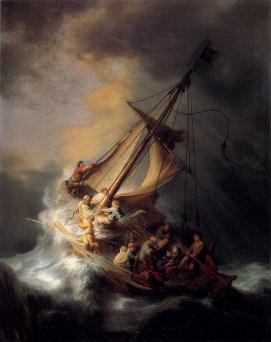
Jesus Stills the Storm Rembrandt

   On that day, when evening had come, he said to them, “Let us go across to the other side.” And leaving the crowd behind, they took him with them in the boat, just as he was. Other boats were with him.

A great windstorm arose, and the waves beat into the boat, so that the boat was already being swamped. But he was in the stern, asleep on the cushion; and they woke him up and said to him, “Teacher, do you not care that we are perishing?”

   He woke up and rebuked the wind, and said to the sea, “Peace! Be still!”

Then the wind ceased, and there was a dead calm. He said to them, “Why are you afraid? Have you still no faith?”

And they were filled with great awe and said to one another, “Who then is this, that even the wind and the sea obey him?

The View from the Boat

Thanks entirely to the kindness of friends, my wife Sarah and I spent five days this week on the island of St. Martin. I had never been to the Caribbean, It is a wonderful and relaxing place; you should go.

As people tend to do when they vacation in that part of the world, we spent a lot of time sitting on a beach looking out at the calm, bright blue water. As I say, very peaceful and relaxing; but the view can seem a little limited.

Sarah had been to the Caribbean before, as a college student sailing with a group of friends. She recalled that the view from the ocean was much more expansive, taking in as it must a broader view of the land, the contours of hills, and the full sweep of beach.

Perhaps that’s why Jesus liked preaching from the boat, set off as it was from the shoreline. It offered a broader view of things.

It had been a busy and hectic few weeks. He had spent so much time in the midst of the crowd; so much time healing the physically ill and spiritually tormented, so much time given over the meeting the needs of the hungry and the afflicted, that perhaps he needed some perspective. Perhaps the boat gave him the space to see the world and his place in it from a fresh vantage point.

Perhaps we all need from time-to-time, that platform from which we can view our world and the people with whom we share it through a different lens.

Perhaps in putting out to sea, Jesus offers us a useful symbol of how the life of faith can sometimes work.

Because if faithfulness and faithful living is indeed rooted in our capacity to trust God above ourselves, we will need those moments when we can look at our lives and our world from a different vantage point. Because our vision is limited, restricted by all that we are and have been learned and experienced. We cannot see the whole of existence on our own; we need perspective to be faithful. We need perspective to differentiate between our own brokenness and the brokenness in the world that God summons us to help in healing.

So, from time-to-time, we need to a seek out new places from which to see the world; a new perch from which to see clearly how God is working, so that we might lend whatever we can to God’s efforts.

Which is why we celebrate those among us who go out and minister, either locally or farther afield. They bring us a fresh perspective and broaden our vision. They bear witness to the surprising ways God continues to redeem the world.  

Father’s Day

For a shift in our perspective to have any transforming effect in our lives requires a willingness to allow a new vision to change the old one.

We must be willing to trust that God will work in ways that we cannot immediately see for ourselves, in ways and through circumstances we might not choose for ourselves, but through new life can reveal itself.

And that requires of us a openness to being vulnerable; a willingness to give up our need to control, to sacrifice our desire for certainty.

Today is Father’s Day, of course; and if your experience of your father is anything at all like mine, vulnerability might not the first word that comes to mind. Nor is ‘letting go of control’ is the first action, for that matter.

As some of you may know, my father was diagnosed with Alzheimers a few months ago. And while it has been slow to progress to this point, his condition has invited our family to change our perspective on his future and on our own. They will both look very different than expected; and in truth, we will have to abandon assumptions held for year about what our shared future holds for him and for us.

In short, we have to come to understand that our living now resembles that of most of humanity; we do not have the ultimate sense of control we might have thought. And at this point, at least, we must simply place our trust in God; and hope faithfully that there is a future that God envisions for my father that we cannot yet see, but that will be revealed in time.

As we wait for that future to shape, we might need to be intentional about shifting our gaze from time-to-time, to look for a different perspective on this terrible illness; to imagine how opportunities for connection and fellowship, for grace and transformation might yet arise from surprising, difficult and painful places.

Perhaps all we need to is to find ways of seeing our life as a family from different angles. As the disease progresses, to find new vantage points from which to imagine opportunities as yet unrevealed.

Going Over to the Other Side

   At the start of our reading from Mark this morning, Jesus suggests to this disciples that they get into the boat and go across to the other side. On first glance, this might seem unimportant to large narrative, a throwaway line anticipating the larger action to come.

We should be cautious. They are very few throwaway lines in Mark’s gospel. Virtually everything is fraught with meaning; even the most mundane detail serves to reveal something.

To this point in his ministry, Jesus has concentrated his time in territory well known to him and his followers. They have traveled through Galilee, along familiar paths and among largely supportive and friendly crowds.

Now, he turns his attention to the other side of the Sea of Galilee. The eastern side. The Gentile side. The side not as well known, not as welcoming or as safe.

Commentators on the early church suggest that Mark is reflecting here on the circumstance of his own community and its own experience of ‘going across to the other side.’ Like many first century disciple communities, the one that produced Mark’s gospel wrestled with issues of inclusion and welcome. Could a messianic expression of Judaism allow full membership to non-Jews? What level of faith and trust would be required of people to adapt their traditional understanding of community and their customary practices of fellowship and worship to broaden their welcome.

Such dramatic shifts in culture are never easy; division and conflict can come among even the most devoted followers of Jesus, tearing at the fabric of the community.

Storms can blow up quickly and with devastating effect.

***************

  In Mark’s universe, storms are much more than simple atmospheric disturbances. They are evidence of diabolic power; they are the forces of chaos gathered to oppose the creative and redemptive impulse of God.

Nowhere was that sense of the diabolical on greater display in our world this week than in the one place perhaps where we least expect: in a prayer meeting, in a church.

Still, the diabolical has the power of infiltrate almost any place. And I am not talking about Satan, about our need to personify evil. Or about any other convenient symbol we might conjure up to shift responsibility away from ourselves.

I am speaking of the power we all possess to defy the good purposes of our Creator; to create for ourselves a personal moral universe, because we cannot abide living under the auspices of something we cannot control.

The evil that manifested itself in that meeting at Emmanuel AME, in Charleston this week, was human. Diabolical, to be sure; but in the original sense of that word as symptomatic of a ‘divided self.’

Decry as we might the shocking evil of a tortured young man, very little is served by our desire to divide ourselves entirely from his actions. For it is not Satan or any other personification of evil that produces such violence; it is the profound, tragic sense of despair and alienation that animates such murderous action.

And we are not served by our attempts to believe otherwise.

In the Boat Together 

Martin Luther King once said that while we may all have come on “different ships, we are in the same boat now.”

Among other things, it was a call to Christian unity in the face of the demonic forces that divided people of God along racial and economic lines; that allowed people confessing a faith in Christ to stand idly by while other people confessing the same faith in the same God were denied the dignity of basic human rights. Or left to languish in a poverty so debilitating to the human spirit, so often resulting in tragic and violent reaction to the certain knowledge that you simply do not count in a society in which human value is too often measured in terms of material wealth.

The death of our brothers and sisters in Charleston, and elsewhere, should remind us of that emphatic truth: We cannot survive sailing along in different ships, assuming that someone else will come to the rescue of our brothers and sisters endangered by the storm.

When Jesus awoke from his sleep, his word of rebuke was directed to the storm, to the forces of repression and violence; but it is not too far a reach to say that those words also spoke to the fear of his disciples as well.

Quiet now! Be calm.

Because fear as much as any other emotion is where the demonic finds it foothold and begins to assemble its power. Nothing else in the arsenal of human emotion has more power to divide us than our fear.

And it is used with such devastating effect in our world.

Fear leads to alienation; to that sense of hopelessness and anger that animates violence in a troubled heart.

The people at Emmanuel AME know the power of fear and alienation all too well. So too to the people of Syria and Iraq and Nigeria.

So let us imagine that Jesus is not simply speaking to the storm; but to the fear the storm occasions in our hearts … and the impulse fear excites in us to turn away, to divide ourselves from the needs and desires of others.

In the years when the forces of tyranny were growing in power in Europe, a group of Christians determined to provide a voice to counter the clamoring noise of hatred and division.

They became what we know today as the World Council of Churches; dozens of Christian denominations devoted to the idea that for humanity to survive, we had to realize that we are all in the boat together; and that what endangers some of us, will ultimately threaten us all.

They sought not power in the face of the rising tide of Nazi and Imperial power; but instead chose a different path. Nothing it seemed could change the immediate future, held so tightly in the grip of violence and hatred.

But perhaps there was the possibility of a different future; one still veiled and hidden, but emerging enough to offer a vision to those Christians faithful enough to look for it, humble enough to give up their sense of control long enough to see the future through a different lens.

While governments looked at ways to counter the rising tide of war, with  war preparations of their own, the World Council of Churches sought to build relationships across borders that would make reconciliation possibility when the wars has ceased.

The symbol they chose for this fairly radical experiment in ecumenical fellowship: a storm-tossed on a raging sea, with a cross for its mast.

A profound acknowledgment of their faith that God stills the storm, and the church is called to be faithful and await that opportunity to place herself at the disposal of God’s healing and reconciling power to give voice to divine word of assurance, comfort, promise and hope: Peace! Be Still!


Stories

   O Lord, you have searched me and known me … Even before a word is on my tongue, O Lord, you know it completely.                                                                                                                                             Psalm 139

   Years ago, when he served as U.S. Senator from New Jersey, Bill Bradley told a story about his father, Warren. Mr. Bradley spent one year in high school but still managed to work himself up to a position as president of the local bank in the small, Missouri river town in which the family lived. This was during the Great Depression, and then as now, countless families were struggling to keep up with their mortgages and hold on to their homes and farms.

   In his story, Senator Bradley said that it was his father’s greatest source of pride that during that awful time, he never foreclosed on a single property.
    I imagined that was possible seventy or eighty years ago because the local banker knew his clients, the homeowners and farmers whose mortgages his bank held. He must have known well, in deep ways … known their stories and the stories of their families. When a crisis arose, the banker called upon that great well of stories to discern the best possible solution to the issue at hand.
   You can almost imagine the conversation between Mr. Bradley and his clients. Banker and farmer sitting across the table from one another, committed to finding a solution that met the needs of both people. The banker’s what can I do to keep you on your farm balanced with the farmer’s what do I need to do to stay on it.

  Conversations like this seem to be in short supply these days. Solutions to problems become more elusive because the parties involved are too often disconnected from one another’s lives. The mortgage on a farm is less likely to be held locally; and the shared stories that made resolution possible in Warren Bradley’s world have no place in our world.

  It occurs to me that communities that take the time to share stories, especially the deep stories of our lives, the stories that speaking to meaning and value, these communities understand that simple organic truth: we are connected to another, bound up in one another’s lives, and our well-being as individuals is entirely dependent on our well-being as a people gathered in neighborhood, community, nation and planet. When that sense of interdependence begins to fray, things fall apart.

I spent three years as a Peace Corps volunteer in Lesotho, in southern Africa. One of the many things I found remarkable about village life there was the sense that people were bound together and that their survival depended upon their willingness to give up something of their own for the well-being and wholeness of their neighbors. They did not always like each other, but they knew they needed each other.

  People rooted in one place for generations have a sense of that. It certainly not ideal in every way, but those of us who are more transient can benefit from the practices that hold village life together: the understanding of shared well-being, of connection and mutuality; the commitment to a common good. They remind us of the deep commonalities that link us together. As a church, we need to find more and more ways of sharing our stories … in worship and in fellowship, in prayer and in study.

  The beautiful words of the Psalmist comfort us with the knowledge that we are deeply known by God. They also challenge us to think that God not only promises closeness and presence, but that the resolve of God is for us to be closer to one another as well.

Crisis Management

August 24, 2014
11th Sunday after Pentecost (Year A)
Exodus 1.8-2.10

Now a new king arose over Egypt, who did not know Joseph. He said to his people, ‘Look, the Israelite people are more numerous and more powerful than we. Come, let us deal shrewdly with them, or they will increase and, in the event of war, join our enemies and fight against us and escape from the land.’ Therefore they set taskmasters over them to abuse them with forced labor. But the more they were oppressed, the more they multiplied and spread, so that the Egyptians came to dread the Israelites. The Egyptians became ruthless in imposing tasks on the Israelites, and made their lives bitter with crushing labor in mortar and brick and in every kind of field labor. They were ruthless in all the tasks that they imposed on them

Introduction
As we look out at it this week, our world seems overrun by one crisis or another.

There is the Ebola crisis in West Africa. More than 1000 people are dead in Liberia, which seems to be tottering on the brink of civil unrest as her people wrestle with the reality of this horrible disease.
There is continued violence in the Middle East. Palestinians and Israelis seem locked in an intractable political conflict which continues to visit suffering on families and children in Gaza.
We all witnessed with shock and grief and anger the craven murder this week of the journalist James Foley by the Islamic fundamentalist group ISIS.
And on the streets of our own country, there was the unfolding spectacle of violence in Ferguson, Missouri, where once again the unresolved racial divide in our country manifests violence, suspicion and anger.
Add to that a continuing climate crisis, unresolved concerns about the health of our economy, worries about the well-being of family members and friends and a host of other things, and we can be forgiven for thinking that the world is coming unglued.
Or if we are given to apocalyptic sensibilities, that the world is coming to an end. Four horsemen just don’t seem to be enough to carry everything that is swirling around us these days.

**************************************

So how does this ancient story from the Exodus help us to make sense of all this?

In the simplest sense, by reminding us that in every age, to every people, come a host of challenges, tragedies, and equally opportunities and the promise of a future.

There are always disasters public and private that plague the life of God’s creation.

Writing in the aftermath of the Christmas tsunami of 2004, the theologian David Bentley Hart (The Doors of the Sea, Eerdmann’s, 2005) suggested that one way of approaching catastrophe and crisis was to understand that a world created by God as a free act of love must bear some portion of that creating freedom. We contend with the cost of that freedom by the ways in which we choose to respond to the world as it is.

The story from the Exodus is a story of catastrophe and crisis, but more essentially, it is story of how people choose to respond.

And is must be said that the writer of this story chooses characters who do not possess any inherent political, economic or cultural power of their own; but respond faithfully and courageously all the same.

**************************************

The whole story of Moses’ birth is rooted in fear and the moral and compassionate response of a few faithful people to public policy borne out of fear.

Pharaoh is the most powerful man in the world, if not in actual fact, then certainly from the perspective of the biblical writer. He is worshipped by his people as a god-king, and has the power of life and death in virtually every aspect of Egyptian life.

And still, he is consumed by this fear that the Israelites living among him and his people present this existential threat to their future. And like much of the fear that seems to drive our actions and our lives, Pharaoh’s fear is baseless. There is nothing in the story to suggest that the Israelites posed any threat to the well-being of Egypt. There are just a lot of them, and that is enough for Pharaoh to turn murderous.

So what do people do in the face of murderous, even genocidal policy, when they themselves have little obvious power to challenge it?

Consider the ways in which the women in our story this morning serve as models of faithful resistance to the power of Pharaoh.

The Midwives
First, the midwives. It is unclear whether they are Hebrews or Egyptians.
Some ancient manuscripts translate the original Hebrew text as ‘midwives to the Hebrews;’ that is, Egyptian women working in the Hebrew community.
Others align more closely with our New Revised Standard Version and portray the midwives as members of the Hebrew community.

Some rabbinical scholars like the idea that they were Egyptian. It affirms the tradition of the righteous Gentile, the morally just foreigner who intervenes on behalf of the children of Israel. In any event, their action is morally commendable and remarkably courageous, given the power of the man whose order they have defied.

The Jewish scholar Tikva Frymer-Kensky (Reading the Women of the Bible, Schocken, 2002) calls them subversives, an underground resistance movement rooted in a deep sense of moral justice and fairness. Whether Hebrew or Egyptian, they are motivated in their actions by a faith in God that compels them to act against the orders of the state and to openly defy the command of Pharaoh.

They do so with invention and wonderful cleverness.

Our text has them telling Pharaoh that the Hebrew women are so ‘vigorous’ that they give birth before we can get to them. Tikva Frymer-Kensky offers an alternative translation. Her reading of the ancient Hebrew has the midwives telling an outraged Pharoah that the Hebrew women are ‘animals’, giving birth on their own before the arrival of the midwives.

This simple turn of phrase distracts Pharaoh, who can only respond in a sort of confused and befuddled way.

The policy collapses; and the threat temporarily subsides.

The Mother of Moses
Moses’ mother does not get a lot of attention in this story, but she subverts the actions of Pharaoh in perhaps the most poignant way imaginable … by giving up her child, not once but twice, as a way of insuring his future.

When she can no longer hide him, she puts her three month  old child in a basket and floats him down the river.  Imagine for a moment the courage and faith and hope it takes to float your newborn down the river, without any assurance that someone will find him and save him.

Moses’ mother subverts Pharaoh’s power through the sheer love she has for her son.

The Sister of Moses
Moses’ mother does send her daughter after the basket to see that what happens to it.

She is named later in the story of Exodus as Miriam. Here she serves as a guardian, of sorts; to insure that her brother remains safe. As see watches events unfold, she intervenes to reunite her mother with Moses. Miriam’s is a small act. She does little more than recognize an opportunity and acts quickly to ensure well-being and security for her family.

Pharaoh’s Daughter
In the very household of the king comes an act of resistance to his rule.

Unlike the midwives, who are moved by justice and fairness, or the mother and sister of Moses, who act out of love and hope, Pharaoh’s daughter acts out of a deep sense of compassion.

She must be aware of the policy regarding Hebrew children. He immediately recognizes Moses as one of them.

Still, moved by pity, she gathers the child up.

Small Acts of Resistance
God does not appear to be an active participant in this story. But the virtues we so often associate with people and communities faithful to God certainly do.
Justice. Love. Compassion.

Three simple virtues, all leading to small acts of defiance, resistance and subversion of an oppressive regime that for people of biblical faith embodies all the destruction and chaos and violence of our sometimes fragile world.

The story of the Exodus continues to speak to us as a reminder that our faith is rooted in a trust that if we act morally and compassionately, even in those moments when love seems dangerous, and we are willing to believe that our lives can subvert the powers that seek to rule our world, then God is present and the power of God is active.

The women in this story are not remarkable or extraordinary.

They merely meet the crisis in their lives with faith and with courage, with some imagination and quick thinking, and with trust that small acts of love and mercy can overwhelm evil.

They are not martyrs; but women ordinary in most respects, acting in out of a courageous and defiant faith. They are made memorable for acting on behalf of other people’s well-being and not their own. In point of fact, their own well-being and their own futures are deeply compromised.
But still they act, and in their small, modest way they overturn the plans of Pharaoh.
In a their small ways, they move the action of God along … the plans collapse, the empire retreats … not forever, but long enough for God’s promise of liberation and deliverance to be born, floated down the river and allowed to grow until the people of God are led out of bondage and into a land of hope and new life.
Thanks be to God.

Christmas In August


2012-12-24 16.27.38And Mary said, ‘My soul magnifies the Lord, and my spirit rejoices in God my Savior, for he has looked with favor on the lowliness of his servant.’                                                                Luke 1.47

Most of us know the nuts and bolts of Charles Dickens’ A Christmas Carol. Through ghostly visitation and a hard, painful look at his past and future, an embittered miser is shown the true meaning of Christmas.
But there is a short, wonderful interlude in the Scrooge narrative that often gets overlooked amid the procession of ghosts and graveyards that has a much to say about grace than anything else in the book. And grace – the unmerited, welcoming love of God – is really what Christmas is all about, after all.
You may know it, but bear with me. Bob Cratchit and his family are preparing for their Christmas dinner. Despite their impoverished circumstances, they seem in a festive mood. Bob, ‘his threadbare clothes darned up and brushed to look seasonable’, comes home from church carrying his young son Tim on his shoulder. Tim is a crippled, as we all know; he walks with a crutch, and his legs are supported ‘by an iron frame.’ As they come into the house, Mrs. Cratchit, like all watchful parents asks how her child comforted himself in church: ‘And how did little Tim behave?’
‘As good as gold,’ answers Bob, ‘and better. Somehow he gets thoughtful, sitting by himself so much, and thinks the strangest things you ever heard. He told me, coming home, that he hoped the people saw him in the church, because he was a cripple; and it might be pleasant to them to remember upon Christmas Day who made lame beggars walk, and blind men see.’ ”
What a remarkable thing: to see in your own infirmity the potential for divine revelation. Imagine how different the world would look to us if we were able to see it through the same lens as a crippled child.
It strikes me that the grace in Tim Cratchit’s reflection lies in his willingness to see beyond the physical limitations of his world, his family’s poverty and his own handicap, beyond the pity others feel for him, to embrace the possibility that God may work through him in ways that exceed his expectations.

The reality that God redeems the world is at the heart of the Christmas story. Our response to that promise of redemption should be a faith rooted in an open-hearted willingness to see God so deeply and graciously inhabiting our lives and circumstances that every moment, every circumstance contains the promise of renewal, restoration and redemption.

It’s the wrong holiday, of course, but Tim’s theology pulses with the hope of resurrection.

Who Is Our Neighbor?

images  Just then a lawyer stood up to test Jesus. ‘Teacher,’ he said, ‘what must I do to inherit eternal life?’ He said to him, ‘What is written in the law? What do you read there?’ He answered, ‘You shall love the Lord your God with all your heart, and with all your soul, and with all your strength, and with all your mind; and your neighbor as  yourself.            Luke 10.25-27

  We know the bones of the story. A young man asks Jesus what he must do to inherit eternal life. Jesus responds by asking him to consider what he knows of scripture. The young man knows that he must love God will his whole self and love his neighbor as he loves himself.
  All well and good. But like many ambitious students who want to impress their professors, the young man goes further. Who is my neighbor, he asks. Jesus responds with the parable of the Good Samaritan, the story of a traveler stopping by the side of a road to help a wounded man.
  On its surface, of course, it is a great story of compassion and hospitality. A man lies bleeding on the roadside, robbed of his money and possessions, ignored by other travelers, among them religious leaders. He is finally helped by a stranger, who bandages his wounds and takes him to an inn and pays for his lodging until he has recovered.
  There are other levels to the story, of course. Many of you will know that the wounded man was a Jew and his rescuer a Samaritan. Jews and Samaritans, in a general sense, despised one another.
  Jesus’ audience would have been shocked and scandalized to hear a Samaritan portrayed in such a positive light. Imagine a German stopping to help a beaten and bleeding Jews on a street in Munich in 1938. Or a native South African stopping to help an Afrikaaner at the heart of Apartheid era violence. Or imagine yourself driving along a road on our southern border today and seeing a young Mexican mother and her children sitting on the roadside, exhausted and dehydrated after days in the dessert without water or food. At any of these points, the challenge of the parable confronts us.
  Who indeed is our neighbor? The people we choose. Or the people God chooses for us? The people yearning for healing and companionship that God places in our path.   
   Jesus intended to shock and to confuse his listeners with this story; perhaps even to offend their deeply-held sensibilities enough to invite a change in perspective.  
  The parable has great power to empower the church to look at our ministry and mission in new ways, because the Good Samaritan is not simply a story about how to live with compassion, but a story that challenges us to look differently at the world in which we live and with the people with whom we share God’s world.

  Ultimately, the parable of the Good Samaritan is a word from God that invites us to expand our closely-held notion of who qualifies as a neighbor. No longer can the church afford to assume that our neighbors are those who look like we do, or speak the same language as we do. Or conform to the same way of expressing their faith as well.

  Much has been written and said recently about the decline of the church. The mainline churches have lost our central role as shapers of public morality. We are no longer the first place people go when are looking for purpose and meaning. Some of this decline is our fault. Across the denominational spectrum, churches become too acculturated; the relationship with the worldly culture grew too cozy and comfortable. Part of our decline has been beyond our control, part of a larger movement of history over which we have little control.

  But decline is not always ‘bad’ news. In every crisis lies the seed of opportunity. Someone wiser than me said that; someone who understood that the future of anything worth preserving does not lie in the pursuit of vanity. Or in paralyzing nostalgia for a past that was never really as good as we remember. 

***************************

 There is this grand Congregational church at the center of a town green in Connecticut. It was the founding church of that town; and has been there for nearly 400 years.

 It has a Waterford crystal chandelier, and an enormous Tiffany stained-glass window portraying the town’s founder. Every spring, the graduating class of the local college processes around it. It survives in part by virtue of a generous endowment. It thrives because it has come to recognize that hand-in-hand with its justifiable pride in its historic place in its community’s as well as it current place amid the current struggles of the city’s poorest and most vulnerable residents. For several years, passersby would marvel at the spectacle of the tents and lean-tos erected along the sides of its glorious Federalist façade.

It is symbol both of the decline of mainline churches and a sign of our rebirth. It can be overly reliant on its history; but at the same time look out of its windows and see the demands of a changing world that invite a new vision of neighborhood and community … and so every year the church invited the homeless of the community to make their homes on its side and back lawns.

 Christians make this odd and mysterious claim: God is incarnate in Jesus Christ. When Jesus offers the parable of the Good Samaritan, he merely reminds his church that we are created and called to model that same incarnational love. It might be stopping by the side of the road to attend to a wounded traveler. It may reaching across a counter to provide a meal to a welcome guest. It may be the simple willingness to broaden our sense of community. It may be nothing more than providing a wall to lean on. 

  If we give the time and attention to stories like the Good Samaritan, if we allow this ancient story to reshape our understanding of ourselves not as a community in decline, but as a fellowship prepared to reclaim ourselves as a place of radical love, extravagant hospitality and gracious and open welcome.
  The United Church of Christ is often found of saying to those who gather with us in worship and mission that no matter who you are or where you find yourself on life’s journey, you are welcome in our churches. Our future lies in our willingness to claim the ancient church’s commitment to welcome and hospitality, to embracing Christ’s notion of an expansive and expanding neighborhood that extends to all the fellowship of God’s people. As the new church year begins and unfolds, perhaps in our conversations, our public meetings and private prayers, we can devote ourselves to how we might best look to this ancient story to shape our future together.

Transition & Change

   Now there are varieties of gifts, but the same Spirit; and there are varieties of services, but the same Lord; and there are varieties of activities, but it is the same God who activates all of them in everyone.
  To each is given the manifestation of the Spirit for the common good. To one is given through the Spirit the utterance of wisdom, and to another the utterance of knowledge according to the same Spirit, to another faith by the same Spirit, to another gifts of healing by the one Spirit, to another the working of miracles, to another prophecy, to another the discernment of spirits, to another various kinds of tongues, to another the interpretation of tongues. All these are activated by one and the same Spirit, who allots to each one individually just as the Spirit chooses.
   For just as the body is one and has many members, and all the members of the body, though many, are one body, so it is with Christ. For in the one Spirit we were all baptized into one body—Jews or Greeks, slaves or free—and we were all made to drink of one Spirit.                                                                                                              I Corinthians 12.4-13

IMG_1415Nearly 2000 years ago, the Apostle Paul wrestled with the challenge of an evolving church when he wrote to the saints gathered in Corinth. Like every thriving church in every age, they honored traditions and practices that they had inherited from preceding generations. But as their community grew, people began to recognize that old structures had to give way to new realities.
But not without some hesitation and struggle. Old ways are hard to give up. So Paul writes to remind his beloved people that it is not the form that matters as much as it is the faith that unifies all the diverse gifts and perspectives of the church.
We all have something to give, something to offer, Paul assures the Corinthians; but he reminds them that what we offer should serve the common good, not merely our personal sense of how things should look and how things should be done. The church is one body, made up of many members; and while we bring all that we are as individuals to it, we are unified by one Spirit and one God.

We belong to the Body of Christ. ‘Belong.’ We all say it; but how often do we take the time to really consider the implications of ‘belonging’ to something.
15 times in his letters to the churches in Rome and Corinth, Paul speaks of ‘belonging.’ For Paul, ‘belonging’ is a way of reminding the faithful in those cities that membership in the church requires a certain sacrifice, a willingness to give ourselves over to the faith of the community, and that in common prayer and shared discernment, we might together find God’s vision for the church. It might not always look exactly how we would like, or sound exactly like we want it to sound, but ‘belonging’ assures us that even in those moments of disagreement, we are bound together.
And being bound together and trusting together that God will lead us is the essence of the church.